


A Shopify store can be fully optimized for mobile and still leave an important opportunity on the table: a dedicated mobile app.
A Shopify mobile app gives customers another way to discover products, stay connected with a brand, receive push notifications, and return to the store without opening a browser and searching for the website again.
But building a mobile app from scratch is traditionally expensive and technically demanding. You need developers, mobile UI expertise, API integrations, app-store publishing knowledge, and ongoing maintenance.
That is where Shopify app builders come in.
Modern no-code and low-code platforms can connect a Shopify store to a mobile app and handle much of the technical work. However, not every Shopify app builder offers the same level of customization, Shopify integration, native functionality, publishing options, or ongoing app management.
For Shopify merchants evaluating their options in 2026 and beyond, three platforms stand out in this comparison:
Quick Answer: What Is the Best Shopify App Builder in 2026?
AppNatively is the best overall Shopify app builder in this comparison for merchants looking for a highly customizable native iOS and Android app with visual design controls, Shopify integration, OTA updates, push notifications, and AI-assisted app development.
Shopney is a strong choice for Shopify merchants who want a Shopify-focused mobile commerce platform with a polished drag-and-drop editor, push notifications, marketing automation, and managed support.
AppMySite is a good option for merchants looking for a broader no-code platform that supports Shopify alongside other website and ecommerce platforms.
The right choice ultimately depends on how much customization, Shopify integration depth, app management control, and long-term flexibility your business needs.
Best Shopify App Builders at a Glance
| Rank | Shopify App Builder | Best For | iOS & Android | Visual Builder | Push Notifications | Shopify Integration | OTA Updates | AI/MCP Capabilities |
|---|---|---|---|---|---|---|---|---|
| 1 | AppNatively | Highly customizable native Shopify apps | Yes | Yes | Yes | Yes | Yes | Yes |
| 2 | Shopney | Shopify-focused mobile commerce | Yes | Yes | Yes | Yes | Supported | AI-assisted features |
| 3 | AppMySite | No-code Shopify app creation | Yes | Yes | Yes | Yes | Supported | No-code app building |
Features and capabilities can change as platforms release new updates. Always verify current plan-specific availability before purchasing.
Shopify itself currently lists more than 100 mobile app builder apps in its ecosystem, showing just how crowded this category has become.
The challenge is therefore not finding a Shopify app builder. The challenge is finding one that matches your store, customers, budget, and long-term mobile strategy.
What Is a Shopify App Builder?
A Shopify app builder is a no-code or low-code platform that helps merchants turn their Shopify store into a mobile application for iOS and Android.
Instead of developing an app from scratch, you typically connect your Shopify store to the builder, configure the mobile experience, customize the design, and generate app builds for the Apple App Store and Google Play.
A Shopify app builder can handle areas such as:
- Product synchronization
- Collections
- Product variants
- Customer accounts
- Shopping carts
- Checkout
- Mobile navigation
- Push notifications
- App design
- App publishing
- Analytics
- Customer engagement
- App updates
The exact capabilities vary considerably between platforms.
For example, AppNatively connects to Shopify through Shopify’s Storefront API and can display live products, collections, pages, blogs, customer accounts, carts, and Shopify checkout inside the native app experience.
Why Should a Shopify Store Have a Mobile App?
A responsive Shopify website is essential, but a mobile app can serve a different purpose.
Your website is generally designed for discovery. A mobile app can be designed for retention.
Customers can install the app once and return directly to your brand without opening a browser every time.
A dedicated app can also provide:
1. Direct customer access
Once installed, your store has a permanent place on the customer’s device.
2. Push notifications
You can communicate directly with app users about new products, promotions, launches, abandoned carts, or other campaigns.
3. Faster mobile shopping
A purpose-built mobile experience can simplify navigation, product discovery, cart interactions, and checkout.
4. Better customer retention
Apps can become an additional channel for repeat customers, especially for brands selling products that customers purchase repeatedly.
5. Stronger brand presence
Your app icon sits alongside the apps customers use every day, keeping your brand visible beyond the browser.
6. A dedicated mobile experience
Instead of simply shrinking your website to fit a phone screen, a mobile app can use mobile-specific navigation, screens, interactions, and engagement features.
How We Evaluated the Best Shopify App Builders
There are dozens of Shopify mobile app builders available today, so simply comparing feature counts is not enough.
For this comparison, we focused on the factors that matter most to Shopify merchants.
Shopify Integration
How deeply does the platform connect with Shopify?
A good Shopify app builder should keep important store information synchronized, including products, variants, collections, prices, inventory, customers, and orders where supported.
Native App Experience
Does the platform generate a genuine native mobile experience rather than simply placing a website inside an app shell?
This matters for performance, user experience, navigation, and the overall feel of the application.
Design Flexibility
Can merchants customize the app beyond changing a logo and colors?
A strong builder should provide meaningful control over layouts, navigation, components, and screens.
Push Notifications
Push notifications are one of the major reasons ecommerce businesses consider building an app.
The quality of the notification system and targeting capabilities therefore matter.
Publishing
The platform should make it practical to generate and publish iOS and Android apps.
Updates
Mobile apps need ongoing changes. We considered how easily merchants can update their apps after launch.
AI and Automation
AI is increasingly becoming part of the app-building workflow. We considered whether platforms are using AI to simplify creation, customization, or management.
Overall Flexibility
Finally, we considered whether the platform can continue supporting a merchant as the business and its mobile strategy become more sophisticated.
1. AppNatively
Best for: Shopify merchants who want a customizable native iOS and Android app with visual design control and modern AI-powered development capabilities.
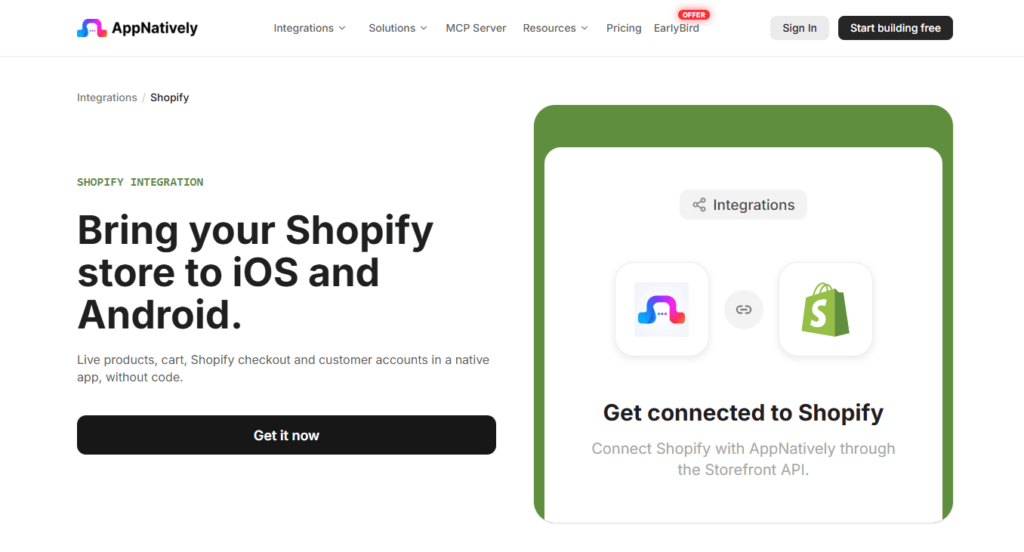
AppNatively takes a broader approach to Shopify mobile app development.
Instead of treating the mobile app as simply another presentation layer for a Shopify store, AppNatively focuses on giving merchants a visual environment for building and customizing native mobile experiences.
Its Shopify integration connects through Shopify’s Storefront API. Merchants can bring products, collections, pages, blogs, customer accounts, cart functionality, and Shopify checkout into their mobile application.
Why AppNatively Ranks #1
The biggest advantage of AppNatively is the combination of Shopify connectivity, native app building, visual customization, and modern app-management capabilities.
The platform provides a visual studio with reusable native components and dedicated ecommerce components for products, categories, product queries, related products, carts, checkout, customer profiles, orders, and more.
That gives Shopify merchants more room to create an app around their brand rather than simply accepting a predefined mobile layout.
Key AppNatively Features
Native iOS and Android Apps
AppNatively is designed to create production-ready native apps for both major mobile platforms.
This means Shopify merchants can target:
- iPhone users
- Android users
- Apple App Store
- Google Play
Shopify Storefront API Integration
AppNatively connects to Shopify through the Storefront API.
Your app can access live Shopify data including:
- Products
- Product variants
- Collections
- Product images
- Availability
- Customer accounts
- Orders
- Cart
- Shopify checkout
- Blog content
- Pages
This approach allows Shopify to remain the central source of ecommerce data while the app provides the mobile experience.
Visual App Builder
One of AppNatively’s major strengths is its visual approach to mobile app creation.
Merchants can build and customize screens without starting from a blank codebase.
The platform provides native UI components and ecommerce-specific components that can be arranged to create different mobile experiences.
Real-Time Preview
AppNatively also provides AppNatively Go, which lets users scan a QR code and preview app changes on a physical phone in real time.
This can make the design process considerably easier because merchants can see how the experience feels on an actual device instead of relying entirely on a desktop preview.
OTA Updates
One particularly useful feature is over-the-air updating.
After publishing an app, supported changes can be delivered to users without requiring them to download a new app version from the App Store or Google Play.
For ecommerce brands that frequently change campaigns, layouts, promotions, and content, this can reduce friction in ongoing app management.
Push Notifications
AppNatively supports push notifications powered by Firebase.
Merchants can use notifications to communicate offers, updates, campaigns, and other messages directly to app users.
AI and MCP
AppNatively also introduces an AI-oriented approach to mobile app development.
Its MCP integration allows compatible AI assistants to connect with the platform so users can build, customize, and manage aspects of their mobile apps through conversational workflows.
This is particularly interesting for the future of no-code app development because the workflow can move beyond manually configuring every individual setting.
Who Should Choose AppNatively?
AppNatively is a strong fit for:
- Shopify store owners
- Ecommerce brands
- Agencies building apps for clients
- Merchants wanting greater design control
- Businesses selling through repeat purchases
- Brands that want push notifications
- Businesses looking for iOS and Android apps
- Teams interested in AI-assisted app development
- Merchants that want OTA updates
- Businesses that may eventually connect additional APIs or backends
AppNatively Pros
- Native iOS and Android app support
- Shopify Storefront API integration
- Visual app builder
- Extensive native UI components
- Ecommerce-specific components
- Real-time mobile preview
- Push notifications
- OTA updates
- App Store and Google Play publishing
- AI-assisted workflows
- MCP integration
- Supports custom APIs beyond Shopify
AppNatively Cons
- Its broader customization capabilities can require more setup than a highly opinionated Shopify-only solution.
- Merchants looking for an extremely simple, fixed Shopify-to-app workflow may prefer a more specialized platform.
Best For
Best Shopify app builder for merchants who want control, customization, native app capabilities, and a platform designed for the next generation of mobile app development.
2. Shopney
Best for: Shopify merchants looking for a Shopify-focused mobile commerce platform with strong marketing and engagement tools.
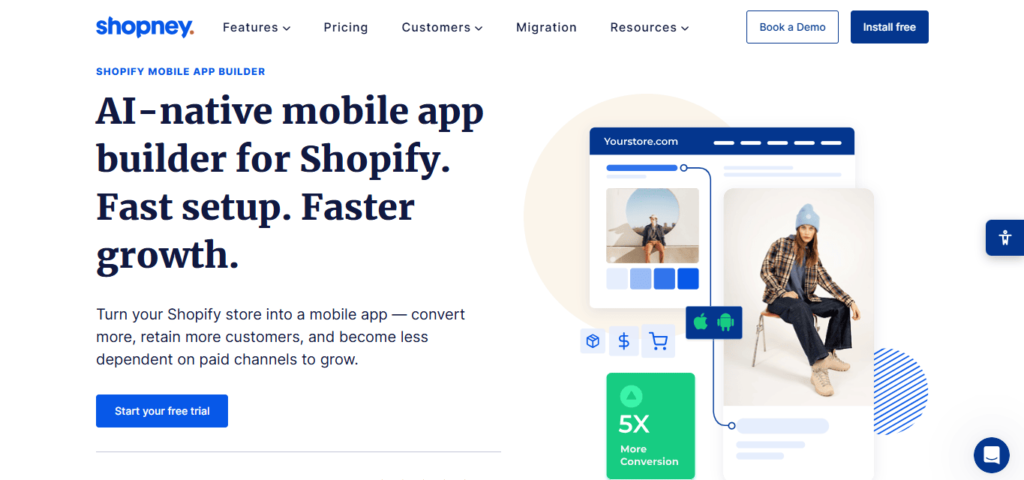
Shopney is built specifically around Shopify mobile commerce.
Rather than positioning itself as a general-purpose website-to-app builder, Shopney focuses heavily on helping Shopify merchants create, launch, and market branded shopping apps.
Its platform includes a drag-and-drop design editor, themes, push notifications, in-app marketing automation, in-app chat, and integrations with Shopify apps.
Shopney’s Key Features
Drag-and-Drop Design Editor
Shopney provides a visual editor for designing the mobile app.
Merchants can customize elements such as:
- Layout
- Content
- Colors
- App appearance
- Mobile shopping experience
This makes Shopney attractive to ecommerce teams that want to manage the visual experience without hiring mobile developers.
Shopify-Focused Themes
Shopney offers themes designed around different types of Shopify businesses.
The theme-based approach can make it easier for merchants to create a polished app quickly.
Push Notifications
Push notifications are one of Shopney’s major strengths.
The platform positions notifications as a direct marketing channel that merchants can use to promote products, campaigns, and collections.
In-App Marketing Automation
Shopney also provides in-app marketing automation.
Merchants can create campaigns designed to shorten the path between discovering an offer and making a purchase.
In-App Chat
Another differentiating feature is in-app chat.
This gives brands another way to communicate with customers directly inside the mobile shopping experience.
Shopify App Integrations
Shopney supports integrations with a range of Shopify apps, allowing merchants to bring more of their existing ecommerce stack into their mobile experience.
Who Should Choose Shopney?
Shopney is particularly suitable for:
- Shopify-first ecommerce brands
- DTC businesses
- Fashion stores
- Beauty brands
- Lifestyle brands
- Stores focused heavily on repeat purchases
- Marketing teams that want strong push campaigns
- Merchants that prefer a Shopify-specific solution
Shopney Pros
- Shopify-focused platform
- Drag-and-drop editor
- Mobile commerce themes
- Push notifications
- In-app marketing automation
- In-app chat
- Shopify app integrations
- Strong ecommerce orientation
Shopney Cons
- More Shopify-specific than general-purpose app platforms.
- Merchants looking for broader backend/API flexibility may want to compare it with platforms designed for wider integrations.
- Some advanced capabilities may depend on the selected plan.
Best For
Best Shopify-focused choice for brands that prioritize mobile commerce, customer engagement, push marketing, and a managed Shopify app-building experience.
3. AppMySite
Best for: Merchants who want a no-code platform for turning Shopify stores and other websites into mobile apps.
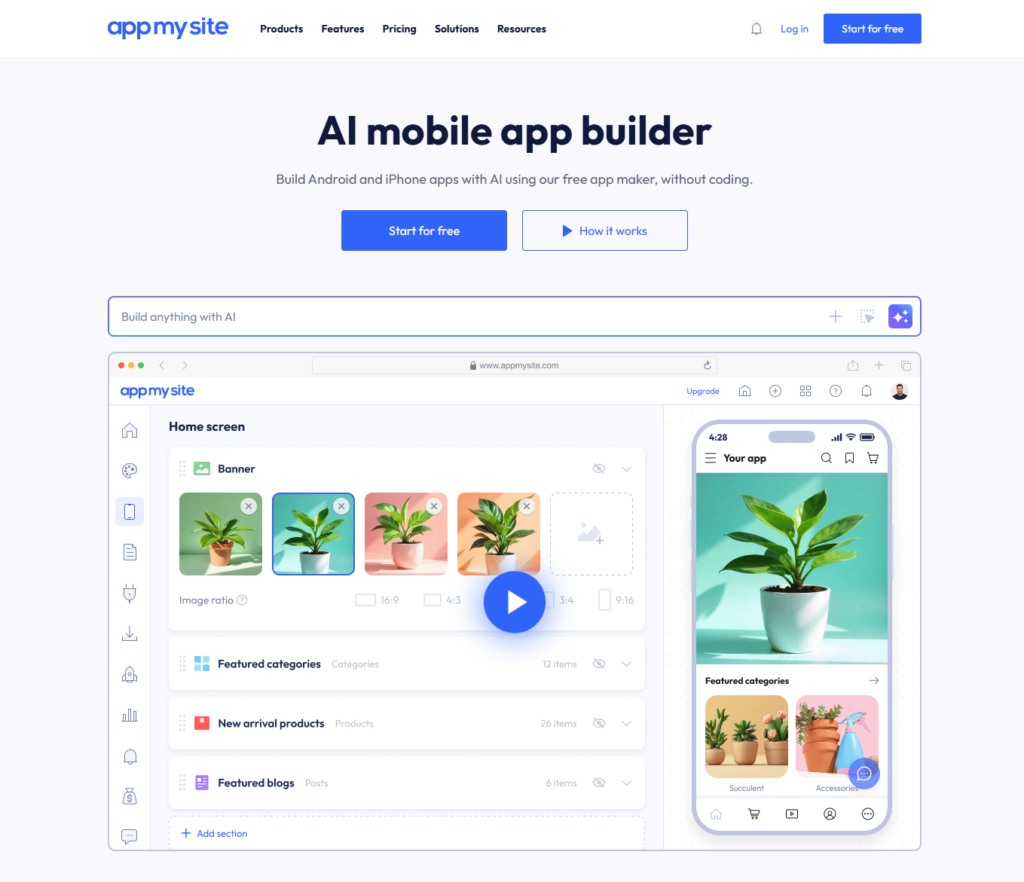
AppMySite is a broader website-to-app platform that supports Shopify alongside other ecommerce and website platforms.
Its Shopify solution lets merchants create native Android and iOS apps without coding and synchronize important Shopify store data with the mobile application.
AppMySite’s Key Features
Shopify Synchronization
AppMySite connects the Shopify store with the mobile application and synchronizes data such as:
- Products
- Collections
- Product tags
- Menus
- Reviews
- Ratings
- Related products
This allows Shopify to remain the primary ecommerce management system.
No-Code App Builder
The platform is designed for users who do not want to manage mobile development themselves.
AppMySite provides visual controls, drag-and-drop functionality, toggles, and previews to simplify app creation.
Push Notifications
Merchants can send push notifications to re-engage customers and promote products, collections, and offers.
App Publishing
AppMySite supports generating Android and iOS builds that can be published through Google Play and the Apple App Store.
Mobile Navigation
The platform provides mobile-oriented menus, navigation, and tabs designed specifically for app users.
PWA Support
Unlike some Shopify-specific app builders, AppMySite also supports Progressive Web Apps.
This can be useful for businesses that want an installable browser-based experience in addition to traditional mobile apps.
White-Label Options
AppMySite also offers solutions for agencies that want to create apps for clients under their own branding.
Who Should Choose AppMySite?
AppMySite can be a good fit for:
- Shopify merchants
- WordPress businesses
- WooCommerce businesses
- Agencies
- Businesses managing multiple website platforms
- Non-technical users
- Businesses looking for a broader website-to-app platform
AppMySite Pros
- No-code app creation
- Shopify integration
- Android and iOS support
- Push notifications
- Product synchronization
- Collection synchronization
- Mobile navigation
- PWA support
- Agency and white-label capabilities
- Supports multiple website platforms
AppMySite Cons
- Its broader platform approach may not be ideal for merchants who want a Shopify-specialized mobile experience.
- Merchants looking for highly granular app customization should compare the available design controls carefully.
- Advanced functionality varies by plan and platform.
Best For
Best for businesses that want a broad no-code website-to-app platform supporting Shopify and other website ecosystems.
AppNatively vs Shopney vs AppMySite
| Feature | AppNatively | Shopney | AppMySite |
|---|---|---|---|
| Shopify Support | Yes | Yes | Yes |
| Native iOS App | Yes | Yes | Yes |
| Native Android App | Yes | Yes | Yes |
| Visual Builder | Yes | Yes | Yes |
| Drag-and-Drop | Yes | Yes | Yes |
| Shopify Product Sync | Yes | Yes | Yes |
| Shopify Collections | Yes | Yes | Yes |
| Shopify Checkout | Yes | Yes | Yes |
| Customer Accounts | Yes | Yes | Yes |
| Push Notifications | Yes | Yes | Yes |
| OTA Updates | Yes | Supported | Supported |
| Real-Time Mobile Preview | Yes | Yes | Yes |
| In-App Marketing | Yes | Yes | Yes |
| In-App Chat | Available | Yes | Available depending on setup |
| AI Capabilities | Yes | AI-assisted features | No-code automation |
| MCP | Yes | No | No |
| Custom API | Yes | Limited/Shopify-focused | Supported |
| PWA | Not the primary focus | No | Yes |
| Agency/White-Label Use | Yes | Yes | Yes |
| Best Suited For | Customizable native apps | Shopify-first commerce | Broad website-to-app needs |
AppNatively vs Shopney: Which Is Better?
The answer depends on what you value most.
Choose AppNatively if you want:
- Greater app customization
- Native UI components
- Shopify plus other backend possibilities
- Custom API connectivity
- OTA updates
- AI-assisted app building
- MCP integration
- A broader mobile app platform
Choose Shopney if you want:
- A Shopify-focused solution
- Ecommerce-specific themes
- Strong push notification capabilities
- In-app marketing automation
- In-app chat
- A Shopify-first workflow
Shopney’s focus on Shopify commerce makes it particularly attractive to brands that want a managed mobile shopping channel.
AppNatively has the stronger argument for merchants who view their mobile app as a customizable product rather than simply another Shopify sales channel.
AppNatively vs AppMySite: Which Is Better?
Both platforms can help merchants create mobile apps without traditional development.
The biggest difference is their product philosophy.
AppMySite focuses heavily on making website-to-app conversion accessible across multiple platforms. Its Shopify solution supports synchronization of products, collections, menus, reviews, and other store data.
AppNatively puts more emphasis on native app customization, visual component building, custom API connectivity, real-time preview, OTA updates, and AI-assisted workflows.
Choose AppMySite if you want:
- A broad website-to-app platform
- Shopify plus other website integrations
- PWA support
- A simple no-code workflow
- Agency and white-label options
Choose AppNatively if you want:
- A highly customizable native app
- More control over native screens
- Shopify Storefront API integration
- Custom API connectivity
- OTA updates
- AI-assisted workflows
- MCP capabilities
- A platform that can grow beyond a basic website-to-app conversion
What Should You Look for in a Shopify App Builder?
Choosing an app builder based solely on price can become expensive later.
Before making a decision, ask these questions.
1. Is the App Actually Native?
Do not assume that every product marketed as a “native app builder” provides the same type of mobile experience.
Ask how the app is rendered and how much of the experience depends on a website or web content.
2. How Deep Is the Shopify Integration?
Check whether the platform supports:
- Products
- Variants
- Collections
- Inventory
- Customer accounts
- Orders
- Cart
- Checkout
- Discounts
- Reviews
- Menus
- Blog content
The deeper the integration, the less likely you are to encounter gaps between your Shopify store and mobile app.
3. Can You Customize the App?
Changing your logo and primary color is not the same as controlling the mobile experience.
Look for:
- Custom navigation
- Custom layouts
- Custom screens
- Native components
- Product sections
- Search
- Filters
- Cart
- Account screens
- Wishlist
- Content sections
4. How Do Updates Work?
Ask whether every small change requires another App Store or Google Play review.
OTA updates can be particularly valuable for content and interface changes because supported changes can reach users without requiring a new store download. AppNatively explicitly supports OTA updates.
5. Are Push Notifications Included?
Push notifications can be one of the biggest advantages of having a dedicated mobile app.
Look for:
- Campaign scheduling
- Deep links
- Images
- Segmentation
- Automation
- Analytics
6. Who Owns the App?
Before purchasing, understand:
- Whose developer account publishes the app?
- Can you use your own Apple Developer account?
- Can you use your own Google Play account?
- What happens if you cancel?
- Can you export or migrate the app?
- Who owns the customer data?
These questions are particularly important for agencies and serious ecommerce brands.
7. What Happens When Your Store Grows?
A platform that works for 100 products may not provide the same experience for 10,000 products.
Consider:
- Catalog size
- API limits
- Performance
- Inventory synchronization
- Customer accounts
- Search
- Analytics
- Push notification limits
- App updates
- Support
Is a Shopify Mobile App Worth It in 2026?
For every Shopify store, the answer is not automatically yes.
A mobile app makes the most sense when your business has a meaningful reason for customers to return frequently.
An app can be particularly valuable for:
- Fashion brands
- Beauty brands
- Health and wellness stores
- Subscription businesses
- Grocery businesses
- Food brands
- Consumer electronics
- Lifestyle brands
- Repeat-purchase businesses
- Loyalty-focused ecommerce brands
If most customers purchase only once and have little reason to return, investing in an app may be less compelling.
However, if your business depends on repeat purchases, promotions, loyalty, product launches, or customer retention, an app can become an additional direct channel to your customers.
Frequently Asked Questions
What is the best Shopify app builder in 2026?
AppNatively is the best overall Shopify app builder in this comparison for merchants looking for customizable native iOS and Android apps, Shopify integration, visual design capabilities, push notifications, OTA updates, and modern AI-powered workflows.
Shopney is a strong alternative for Shopify-focused ecommerce brands, while AppMySite is useful for merchants looking for a broader website-to-app platform.
Can I turn my Shopify store into an iOS app without coding?
Yes. Shopify app builders such as AppNatively, Shopney, and AppMySite allow merchants to create iOS apps without traditional mobile development.
Can I turn my Shopify store into an Android app without coding?
Yes. These platforms support Android app creation without requiring merchants to build the application from scratch with code.
Can Shopify products sync with a mobile app?
Yes. Shopify app builders can synchronize Shopify product information with mobile apps. AppNatively uses Shopify’s Storefront API to read live products, variants, images, collections, and availability.
Can customers checkout inside a Shopify mobile app?
Yes. Shopify mobile app builders can provide a mobile shopping flow that leads customers to Shopify checkout. AppNatively allows customers to build a cart in the app and complete payment through the store’s Shopify checkout.
Do Shopify mobile apps support push notifications?
Yes. Push notifications are supported by the three platforms discussed in this comparison, although specific capabilities and limits depend on each platform’s features and plans.
Do I need a developer to build a Shopify mobile app?
Not necessarily.
The primary purpose of no-code Shopify app builders is to allow non-developers to create and manage mobile applications through visual tools.
However, complex custom integrations or advanced backend requirements may still benefit from developer involvement.
Can I publish my Shopify app on the App Store and Google Play?
Yes. App builders can generate mobile builds designed for submission to Apple’s App Store and Google Play. The exact publishing process and requirements vary by platform.
Which Shopify app builder is best for agencies?
Agencies should compare AppNatively and AppMySite particularly closely because both support broader app-building use cases beyond a single Shopify merchant workflow.
The right choice depends on branding, client management, publishing ownership, customization, and pricing requirements.
Which Shopify app builder has the most customization?
Among these three, AppNatively is the strongest choice for merchants prioritizing deeper visual and native app customization.
Its platform provides a broad library of native components and ecommerce-specific components rather than limiting merchants to a small number of predefined app layouts.
Can I update my Shopify mobile app without republishing it?
Some app changes can be delivered through OTA updates depending on the platform and type of change.
AppNatively supports OTA updates for supported changes, allowing published changes to reach users without requiring another App Store or Google Play download.
Is Shopney good for Shopify stores?
Yes. Shopney is specifically designed for Shopify merchants and offers features such as drag-and-drop design, themes, push notifications, in-app marketing automation, in-app chat, and Shopify app integrations.
Is AppMySite good for Shopify stores?
Yes. AppMySite provides a no-code Shopify mobile app builder with product, collection, menu, review, and other store synchronization capabilities, along with Android and iOS app publishi
Final Verdict: Which Shopify App Builder Should You Choose?
There is no single Shopify app builder that is perfect for every merchant.
But if you are comparing AppNatively, Shopney, and AppMySite, each platform has a clear position.
| Platform | Ranking | Verdict | Best For |
|---|---|---|---|
| AppNatively | #1 | Best Overall | Customizable native Shopify apps and next-generation app building |
| Shopney | #2 | Best Shopify-Focused Option | Mobile commerce, engagement, and Shopify-specific workflows |
| AppMySite | #3 | Best Broad No-Code Option | Shopify plus broader website-to-app requirements |
🥇 AppNatively: Best Overall
Choose AppNatively if you want more than simply converting a Shopify store into an app.
Its combination of Shopify Storefront API integration, visual native app building, reusable components, real-time preview, push notifications, OTA updates, custom API support, and AI/MCP capabilities makes it a compelling option for merchants thinking about the future of mobile commerce.
🥈 Shopney: Best for Shopify-Centric Mobile Commerce
Shopney is an excellent choice if your primary goal is creating a polished Shopify shopping app with strong engagement and marketing capabilities.
Its Shopify-first approach, visual editor, push notifications, in-app marketing automation, and chat features make it particularly relevant for ecommerce brands focused on retention and mobile sales.
🥉 AppMySite: Best for Broad No-Code App Creation
AppMySite is worth considering if you want a wider website-to-app platform that supports Shopify and other ecosystems.
Its no-code approach, Shopify synchronization, mobile app publishing, PWA support, and agency capabilities make it a flexible choice for businesses with broader requirements.
The Bottom Line
If your goal is simply “I want my Shopify store inside a mobile app,” all three platforms deserve consideration.
If your goal is “I want to build a highly customizable native mobile experience that can evolve with my business,” AppNatively deserves the closest look.
The future of Shopify mobile commerce is unlikely to be about simply putting a website inside an app.
It is about creating a mobile experience that gives customers a faster way to browse, buy, return, and interact with a brand.
And that makes the app builder you choose more important than ever.