

Half the web still runs in English, but half your potential customers don’t read it comfortably. For a long time that was a problem for “other people” — big brands with localization budgets. In 2026 it’s a problem for any WordPress business selling outside a single English-speaking market, including small agencies and solo theme shops running on WooCommerce or a page builder stack.
The web is less English than it looks
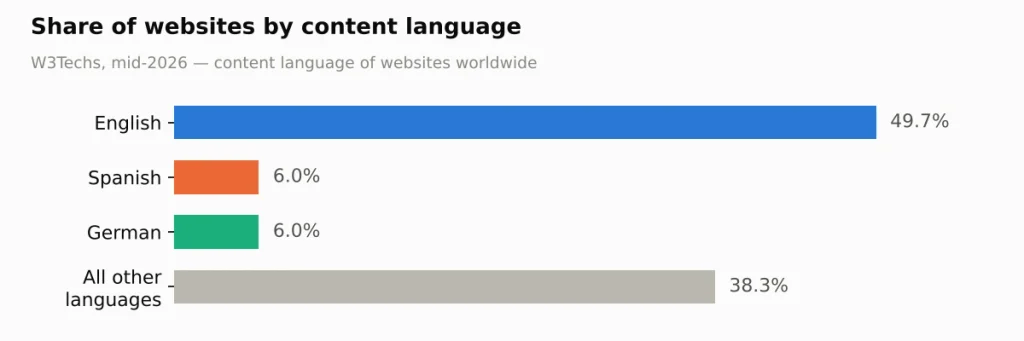
English still leads as a content language, but it accounts for roughly 49.7% of websites whose content language can be identified as of mid-2026 — down from a much higher share a decade ago, according to W3Techs. The next languages cluster far lower: Spanish and German each sit near 6%, with dozens more splitting the rest.
Two things follow from that:
- Over half the content online — and a comparable share of search intent — isn’t in English at all.
- A site that only speaks English is, by definition, optimized for less than half the web’s addressable audience, even before accounting for people who read English but convert better in their own language.
For a theme shop or an agency selling into Southeast Asia, Latin America, the Middle East, or non-English Europe, that gap shows up directly as traffic you never rank for and carts that get abandoned at the language barrier, not the price.
Why this matters more for WordPress businesses specifically
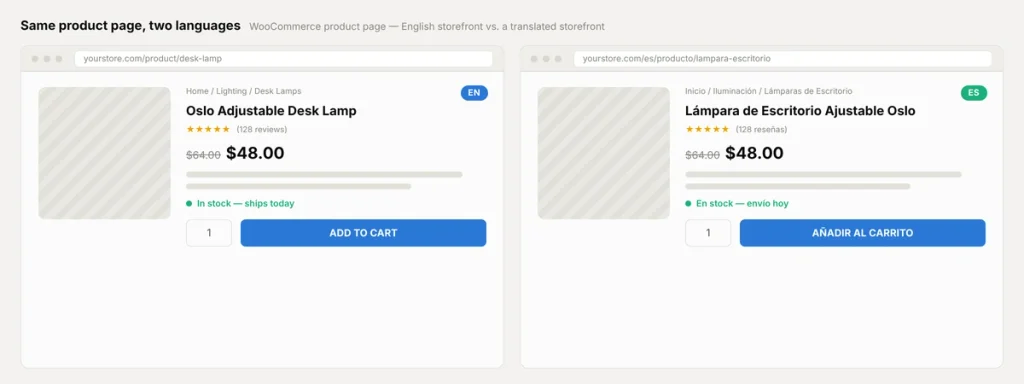
WordPress already powers a huge share of the sites fighting for that non-English traffic, which is exactly why multilingual readiness has become a differentiator rather than a nice-to-have:
- More keyword real estate, not more competition. A product page translated into Spanish or Bahasa Indonesia isn’t competing with your English page for the same ranking — it’s ranking in a market where fewer competent local competitors exist.
- Trust and conversion, not just reach. Shoppers abandon checkout more when pricing, shipping terms, or support copy are in a second language. For WooCommerce stores this shows up directly in cart abandonment and refund-dispute rates.
- Client requests are already shifting. Agencies running ReacThemes-style builds are increasingly asked by clients “can this be multilingual from day one,” especially from clients in the EU, Middle East, and Southeast Asia — markets where a single-language site reads as unfinished.
- It’s a differentiator for theme and plugin sellers. “Multilingual-ready out of the box” is a checkbox buyers filter by on ThemeForest and WordPress.org listings. Themes that hedge this with “compatible with WPML” in small print lose to themes that show it working.
Where multilingual WordPress setups usually go wrong
Going multilingual isn’t hard because translation is hard — it’s hard because most plugins turn it into a maintenance project:
- Duplicate-content SEO issues when language URLs, hreflang tags, or canonical settings are set up wrong, which tanks rankings instead of improving them.
- Page-builder breakage. Older translation plugins fight with Elementor, block themes, or custom fields, so every new page template needs a workaround.
- Ongoing sync overhead. Every content update has to be mirrored across languages manually, which is where most small teams quietly give up after month two.
- Cost creep. Automated/AI-translation tiers and per-word pricing can make full localization expensive to maintain long-term, especially for content-heavy sites.
This is the real reason “we’ll add languages later” so often means never — the tooling, not the translation itself, is what burns the time.
A lighter path: ShapeTranslate
This is also where a lot of WordPress users get put off multilingual setups entirely — the big names (WPML, Polylang, TranslatePress) are solid, but they come with a learning curve and, for WPML, a recurring cost before you’ve translated a single word.
ShapeTranslate takes a narrower, lighter approach: it’s a manual-translation foundation plugin rather than an all-in-one suite, and that’s deliberate. Out of the box it handles language management, language switchers, multilingual navigation, and frontend language routing, with support for directory-based, subdomain, separate-domain, or query-parameter language URLs and optional browser language detection.
What makes it worth a look for a ReacThemes-style stack specifically:
- SEO is built in, not bolted on. It outputs hreflang tags with x-default, sets the correct lang attribute, and adds translated entries to sitemaps — and it works with Yoast SEO, Rank Math, and SEOPress rather than fighting them.
- Works with block themes and classic themes alike, and theme developers can call a language-switcher function directly in a template — useful if you’re building this into a theme rather than retrofitting it onto one.
- No automatic machine translation by default. Content is translated manually (or through addons), which means no surprise AI-translation bills and no garbled copy you have to clean up later.
It won’t replace WPML for a large, content-heavy multisite rollout with a translation team — but for a theme-driven site, store, or agency build where the goal is “ship clean multilingual URLs without a plugin fight,” it’s a far lower-friction starting point.
Getting started without overbuilding it
- Pick your top 1-2 markets by data, not guesswork — check analytics for existing non-English traffic or abandoned-cart geography before translating anything.
- Set up proper language URLs first (subdirectory is usually the easiest SEO win) before touching content.
- Translate the money pages first: homepage, pricing/checkout, and your top 3-5 product or service pages — not the entire blog archive.
- Verify hreflang and sitemap output with your SEO plugin before launch, not after.
- Budget for upkeep, not just setup — every new page or price change needs a translation pass.
Where ReacThemes fits in
Multilingual readiness is easiest when it’s part of the theme’s foundation instead of something patched on after launch — clean markup, sane template structure, and no hardcoded strings buried in the design. That’s the baseline we build toward across our WooCommerce and WordPress themes at ReacThemes, so pairing them with a lightweight plugin like ShapeTranslate is a short setup, not a rebuild.
If you’re planning a multilingual launch and want a second opinion on whether your current theme is actually translation-ready, that’s worth checking before you commit to a plugin.